
You’ve seen it dozens of times. A big red “50% OFF” sign. A crossed-out original price. A countdown timer ticking toward midnight. And somewhere in the back of your mind, a nagging feeling: was it actually that price to begin with?
In many cases, your instinct is right. Fake discounts — where retailers inflate prices before a sale to make the “saving” look bigger than it really is — are one of the most common forms of misleading conduct in Australian retail. The good news is that Australian consumer law is cracking down on it hard, with significant Federal Court penalties handed down in the past two years. The better news is that with the right knowledge and tools, you can spot it yourself.
This guide covers how fake discounts work, what Australia’s consumer watchdog has done about them, the warning signs to look for, and how to verify whether a deal is genuinely worth your money.
What is a fake discount?
A fake discount — sometimes called an “illusory discount” — is when a retailer advertises a product at a reduced price, but the “original” price it’s been reduced from was either made up, was only charged for a very short period, or was never the real regular price.
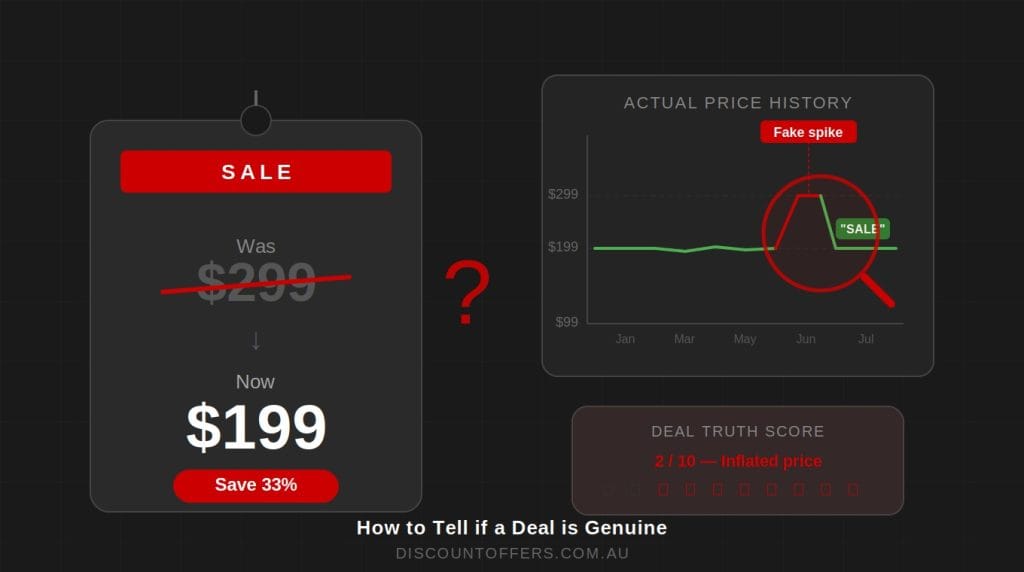
The classic example: a retailer sells a blender for $60. Before a sale, they quietly raise the price to $80 for a week or two. Then during the sale they drop it back to $60 and advertise it as “Was $80 — Now $60: Save $20.” The customer sees a 25% discount. The reality is there’s no discount at all — the price is exactly what it was before.
This is not a hypothetical. The Federal Court has ruled on exactly this type of conduct at some of Australia’s largest and most trusted retailers.
What Australia’s consumer watchdog has found
The Australian Competition and Consumer Commission (ACCC) has made misleading pricing one of its top enforcement priorities for 2025–26. Here is what recent Federal Court proceedings have established.
Australia’s supermarkets: the “Down Down” and “Prices Dropped” cases
In September 2024, the ACCC commenced separate Federal Court proceedings against Australia’s two largest supermarket chains over their promotional pricing campaigns. The ACCC alleged that both chains temporarily raised prices on hundreds of everyday products by at least 15 per cent for a short period, then placed those products on promotional “discount” programs — at prices that were still higher than, or the same as, what shoppers had been paying before the spike. Products allegedly involved included staple groceries that millions of Australians buy every week.
In one of those cases, the Federal Court has since found that the supermarket made misleading representations in 13 of the 14 promotional tickets examined. The other case remains before the court.
Former ACCC chair Allan Fels described the combined cases as “the case of the century” — not because the conduct was especially novel, but because of the scale. The ACCC said the two chains had sold tens of millions of allegedly misleadingly discounted goods and derived “significant revenue” from the practice. Read the ACCC’s full media release here.
Black Friday “sitewide” sales that weren’t sitewide
In June 2025, three major Australian retailers paid penalties totalling $59,400 after the ACCC issued infringement notices over alleged false and misleading Black Friday sales claims. The ACCC alleged the businesses falsely described their sales as “sitewide” when significant exclusions applied — in one case, an “Extra 20% off sitewide” claim did not actually apply to all products. The three retailers operate in jewellery, homewares, and hair and beauty respectively.
In November 2025, the ACCC ran another Black Friday enforcement sweep targeting misleading tactics — including countdown timers that didn’t correspond to actual sale durations, false site-wide claims, and deceptive strikethrough pricing. Investigations from that sweep are ongoing.
The mattress company that made $134 million from fake discounts
In one of the most striking recent cases, the Federal Court ordered an online mattress supplier to pay $15 million in total penalties for making false or misleading representations about its sale prices. The company admitted that 58 of its 74 products had never previously been sold at the strikethrough price displayed on its website. It also used a countdown timer that reset itself when it expired — creating artificial urgency that simply wasn’t real. The conduct affected over 4.9 million website visitors and generated more than $134 million in revenue.
The travel booking site and misleading airfares
Fake discounts extend well beyond retail goods. In July 2025, an online travel agency was ordered by the Federal Court to pay $9 million in penalties for making false or misleading claims about its advertised airfares under the Australian Consumer Law.
The tactics to watch out for
Based on what the ACCC has identified across multiple investigations, these are the most common ways retailers mislead shoppers on pricing:
1. Was/Now pricing without a genuine “was”
The most common tactic. A product is shown with a crossed-out “was” price and a lower current price. The “was” price may have only applied briefly, may never have been the real regular price, or may have applied in only one sales channel. Under Australian Consumer Law, a “was” price should reflect what the product was genuinely sold for over a reasonable period before the promotion.
2. Price spikes before sales
This is exactly what the supermarket Federal Court case established. A retailer raises prices in the weeks before a sale event, then drops them during the sale and markets the drop as a discount. Without access to historical price data, most shoppers have no way of knowing the price was recently inflated.
3. Countdown timers that aren’t real
The ACCC has specifically flagged countdown timers that reset or don’t correspond to actual sale durations. In the mattress case above, the timer simply reset when it expired. If a sale “ends tonight” but the same price is there tomorrow, the timer was misleading — and potentially unlawful.
4. “Site-wide” sales that aren’t site-wide
The ACCC’s Black Friday investigations repeatedly found claims of site-wide sales with exclusions buried in fine print. A “20% off everything” banner that doesn’t apply to sale items, new arrivals, or specific brands is not 20% off everything — regardless of what the fine print says.
5. “Up to” discounts on almost nothing
“Up to 70% off” might technically be true if a single item is 70% off, even if the vast majority of items are discounted by 10% or less. The ACCC specifically flags claims where the “up to” text is not prominently displayed, or where very few products actually reach the headline discount.
6. Anchor pricing with inflated RRP
Some retailers set a “Recommended Retail Price” (RRP) that is significantly higher than what the product actually sells for anywhere. If a product’s RRP is listed as $299 but it has never sold for more than $199 at any major retailer, a price of $179 is not “40% off RRP” in any meaningful sense.
How to verify a deal yourself
The most effective defence against fake discounts is price history data — knowing what a product has actually sold for over time, not just what the current “was” price claims.
Check price history aggregators
Independent price comparison and aggregation sites can help provide additional pricing context. If a product has been selling at a similar price for some time, the advertised saving may not be as significant as it appears.
Use Google Shopping’s price history
Google Shopping now shows price history graphs for many products. Search for the product, click the Shopping tab, and look for a graph icon near the price — it shows how the price has moved over recent months. A price that has been “on sale” for six consecutive months is not a sale.
Compare across retailers
A product genuinely on sale is usually cheaper than what competitors charge. If a retailer claims 30% off but every competitor has the same product at the same or lower price, the “discount” is almost certainly against an inflated reference price.
How DiscountOffers approaches this problem
We built the Deal Truth Score (DTS) specifically because we were tired of seeing shoppers misled by the same tactics the ACCC has been prosecuting. Every deal on our platform is given a score from 1 to 10 based on where today’s price sits relative to the product’s actual tracked price history.
A score of 8 or higher means the current price is genuinely at or near its historical lowest — not just low relative to an inflated “was” price. A score of 4 or below signals the discount is likely misleading or the price is higher than typical. We track prices daily across major Australian retailers and verify every deal independently before it goes on the site.
We don’t accept retailer-provided original prices at face value. If a deal doesn’t pass our verification process, it doesn’t appear on the site. You can browse our verified deals and read more about how the Deal Truth Score works.
Your rights as an Australian consumer
Under the Australian Consumer Law (Schedule 2 of the Competition and Consumer Act 2010), retailers are prohibited from making false or misleading representations about prices. This includes:
- Advertising a “was” price that was never genuinely charged for a reasonable period
- Using countdown timers that create false urgency
- Claiming a site-wide sale when significant exclusions apply
- Inflating a reference price to make a discount look larger than it actually is
If you think a retailer has misled you on pricing, you can report it directly to the ACCC. The cases outlined in this article all originated from consumer reports. Your report matters.
The bottom line
Fake discounts are not fringe behaviour from obscure online operators. They have been found or alleged by the Federal Court at Australia’s largest supermarket chains, major retail chains, and well-known online brands — all within the past two years. The ACCC has made misleading pricing a top priority and the courts have shown they will impose substantial consequences: millions of dollars in penalties, corrective notices, and compliance programs.
As a shopper, the single most useful thing you can do is check price history before you buy. A genuine discount is measurably lower than the product has historically been priced — not just lower than a number the retailer decided to cross out last week.
That’s exactly what we’re here to help with.
Sources: All enforcement actions referenced in this article are sourced from official ACCC media releases and Federal Court findings. Links to the relevant primary sources are included throughout. This article is for general consumer information only and does not constitute legal advice. Readers should refer to the linked ACCC sources for full details of each matter.